Charging an EV at home without a driveway

Last updated: Dec 2nd 2025
It’s possible to install a smart home charger at your property, even if you don’t have access to off-street parking.
This guide is going to explain all the solutions and funding available to help get you into an electric car or plug-in hybrid and access all the benefits that can be unlocked by charging at home, even without a driveway.
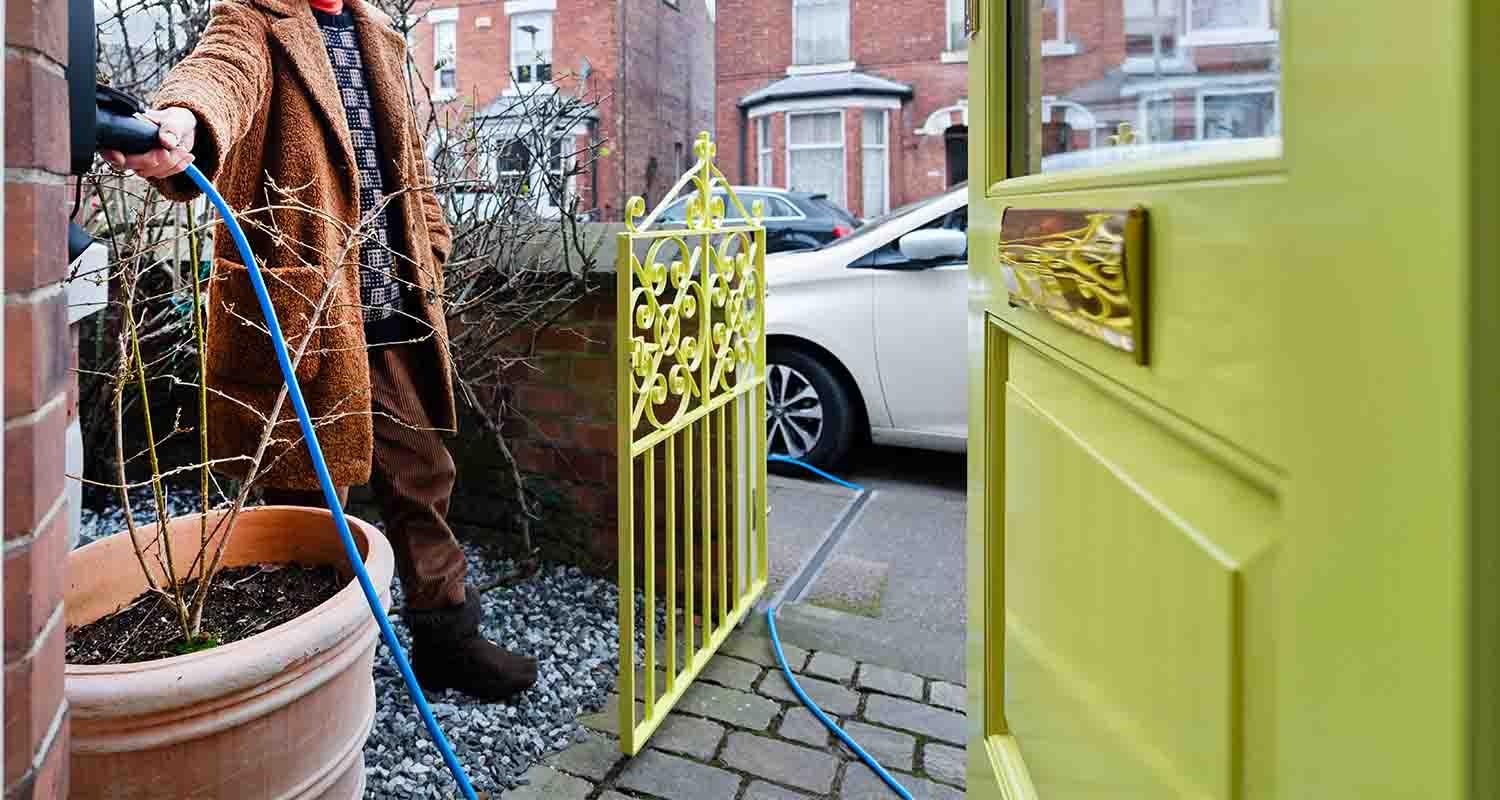
You can have a home EV charger installed even if you don't have a driveway or access to off-street parking. Just make sure you understand any rules your local council may have regarding cables trailing across public walkways, and get permission from your neighbours if any work needs to be carried out on their property as part of your EV charger installation.
Can I have a home charging point installed if I don't have a driveway?

It’s worth just addressing this straight away. There are now multiple solutions available to you to install a home electric vehicle charger, even without a driveway.
Charging "gullies" can put a safe and secure solution through the pavement that a cable can slot into to reach where your electric vehicle is parked on the street. Another alternative are charging "arms" which reach up and over the pavement although these are a rarer sight.
There is funding in place for cross pavement solutions that can help lower the cost to get these options in place before your smart home charger installation.
However, there are a number of checks you should make before making your purchase - some are common to any customer thinking about installing EV charging points at home, while others are specific to those who do not have off-street parking which we run through below.
The common considerations includes things like thinking about the length and complexity of the cable run, as well as how the installer (such as Smart Home Charge) will connect the charger to a power source, to name a few.
All smart home charging devices also need to connect to the internet, either through WiFi or through a 4G/5G mobile connection.
It's worth checking if you can get a stable connection to either by standing where you're likely to put the charger and seeing if you can connect to either on another device like a smartphone.
But what are the considerations specific to those without off-street parking?
1. Can you reliably park outside the front of your house?
Those living in terraced housing or at properties that don't have driveways will already know how regularly they can park outside their property, or how close by on their street.
If you know you can get right outside your house or within one car either direction in front of your house, then it's possible to run a cross paving solution like a charging gully or a charging arm.
You need to factor in the length of that cable run and then give yourself enough extra slack in the instance that you need to connect slighter further from your property.
2. Charging cable length
An additional element to consider here is also to think through whether you want a tethered or untethered charger. A tethered charge point has the charging cable built in meaning you are limited to what the manufacturer offers, which usually maxes out at 10 metres.
We generally recommend an untethered option as this allows you to separately purchase a much longer charging cable - for example, you can purchase a 15m, 20m, or 30m cables to give you extra flexibility.
3. Do you have access to private parking elsewhere? (i.e. around the back of the property)
If you have a dedicated parking space, for example to the rear of the property, it might be possible to run the power cable and locate the charger nearby.
The route and complexity will depend on your individual situation. For example, if the cable run needs to go underground or under floorboards this will need to be factored in.
There are many possible solutions and routes to take, so don't rule it out if it doesn't seem straightforward.
4. Crossing neighbouring properties
You will need permission if any part of the installation trails over someone else's property.
Get formal and written agreements in place before going ahead with any quotes for an installation.
Compare EV chargers
Looking for an EV charge point but are unsure which one to choose? Check out our EV charge point comparison tool and compare our chargers side-by-side.
Can I run my EV charging cable across the pavement?
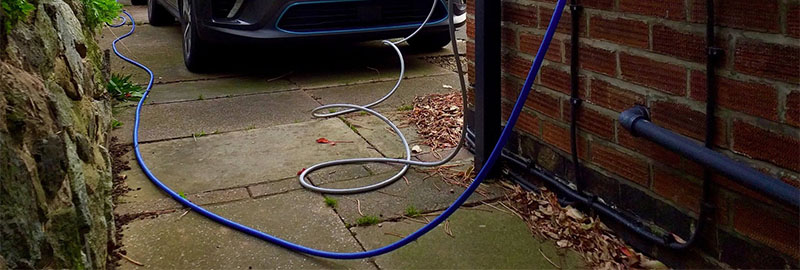
Trailing a cable across the pavement is one of the biggest barriers to having a home EV charger without a driveway.
Doing so without permission is classed as an offence and in breach of the Highways Act 1980 Section 162 and Section 178.
This is why it's important to gain the correct permissions when you're looking into solutions.
Some local authorities allow charging cables to run across a public footpath, so long as it is removed as soon as possible after a charging session has finished. Other councils advise against it altogether, so it's worth checking where you stand in your local area.
A big factor on whether you want to trail a cable, rather than use a gully or charging arm, is around liability if anything should go wrong.
If a pedestrian, wheelchair user or cyclist is injured as a result of a trailing cable, you would be legally responsible for whatever happens as a result of your cable.
Whereas if a cable is correctly inserted into a charging gully, it would be impossible for it to obstruct anyone on the public footpath.
Ultimately, the liability and responsibility will sit with you the homeowner or tenant, so it's very important you check the local guidance.
Get a cable cover
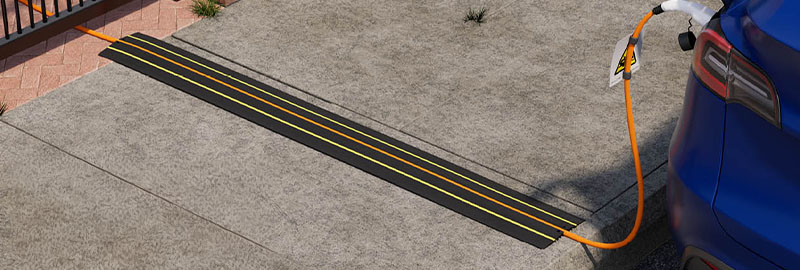
Smart Home Charge has D-Line charging cable covers available that act as a solution to help tidy and contain cables when in use on a pedestrian footpath.
The D-Line cover has an ultra-low profile, it's easy to use and has been safety tested for pedestrian traffic. It's also worth checking with your council to see if you need permission to use a cable cover.
Cable gullies
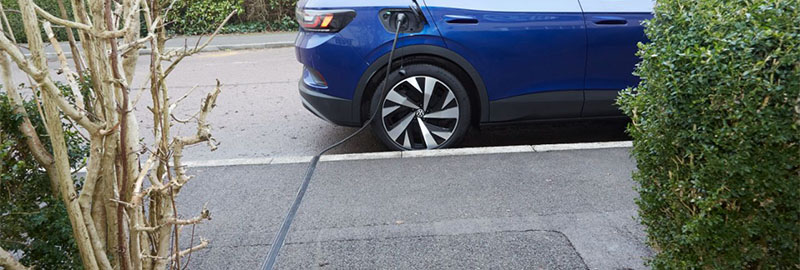
Cable gullies are an increasingly popular option and many local authorities are approving solutions across the UK.
Cable gully companies work with councils to get approvals for installs on behalf of customers and can channel a route across a public pavement so you can easily charge your EV close by to your house.
It creates a permanent trench or "gully" in the pavement, which you can run the cable through when charging your vehicle.
Electric vehicle drivers can insert their cables securely into a gully with lids that are able to withstand 15kN of pressure, which is equivalent to an articulated lorry driving over the top.
Installing a gully will generally take between 1 hour to an hour and a half. An engineer or highways contractor will come and visit the location, chat through the location for the gully and then get on with the installation. After that, it’s ready to be used with your charging point.
Kerbo Charge or Gul-e by ODS are a couple of proven options that are working directly with local councils to install charging gullies.
Kerbo Charge is working with 31 local authorities and you can learn more about the business with our in-depth interview with co-founder and chief executive Michael Goulden.
Charging arms
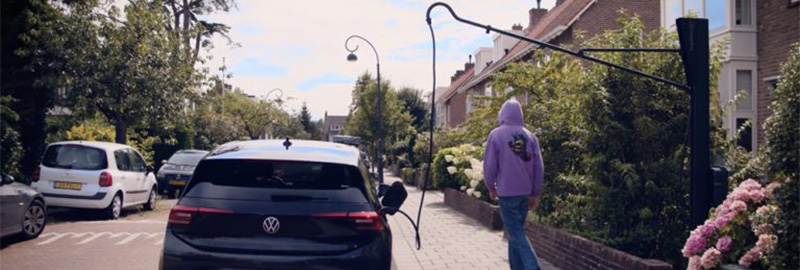
Charging arms usually sit in a front garden and can reach up and over pavements with a safe and secure solution to charge an EV.
The charging arm often folds away neatly when not in use and has enough height to provide ample clearance for pedestrians or cyclists.
Dutch-company ChargeArm offer solutions for front gardens as well as for wall mounting for those that don't have a front garden.
SGS Energy is also offering charge arm solutions in the UK.
Are there any grants available for cross-pavement charging solutions?
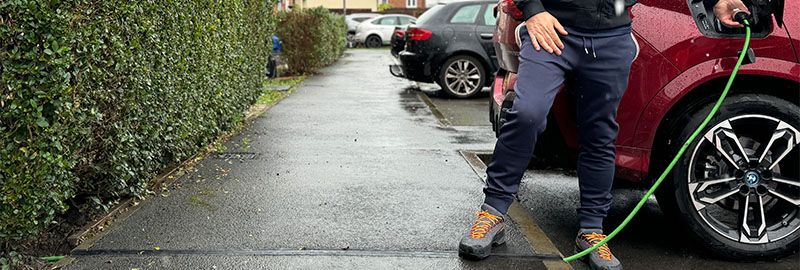
EV drivers can apply for £350 towards funding a cross pavement solution.
The grant provides EV drivers with support towards the costs of the purchase and installation of EV chargepoints at residential properties if they are also installing a cross-pavement charging solution (e.g. a cable channel). You can get 75% off the cost to buy and install a socket, up to a maximum of £350.
The Government also launched a £25 million scheme in July to support local authorities to provide cross-pavement channel charging solutions.
The fund covers all capital costs to install pavement channels, up to an average of £1,200 per channel. This includes, but is not limited to, hardware costs, installation costs, S50 licences, and planning applications.
This is currently only available to local authorities, so it means raising this with your council or engaging with them on this issue to make sure they're applying and able to access funding.
The funding is also only in relation to charging gullies, so charging arms or charging mats aren't currently eligible for any of this grant funding.
Transport Scotland also has a cross-pavement charging grant available with funding of up to £3,500.
This is only available in certain areas, including East Lothian, Perth and Kinross and Renfrewshire.
What options do I have if I can't have a home EV charger?
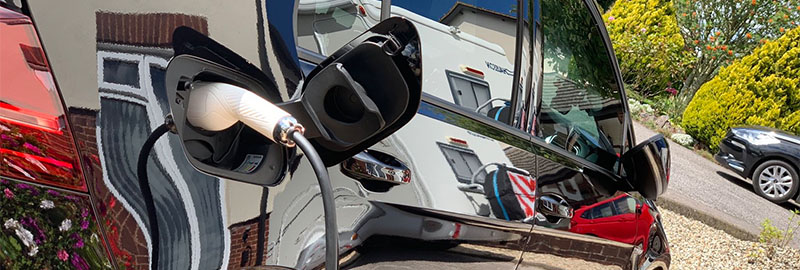
If you've reached this point in the guide and determined that it might not be possible for a home charger, there are still options available to you if you.
Peer to peer charging
Charge point sharing services like Co-Charge, Zap-Home and JustCharge means you can still access the benefits and prices of home charging, and potentially lower charging costs .
Hosts that already have a home charger installed can rent out their charger for a fee to help you reliably charge your EV.
The host gets paid for the energy used and the chargee can access a much lower price for a charge session at a convenient location that will save them money compared to using public charging networks.
Be sure to check out our interview with Co-Charger's founder Joel Teague.
Use public EV charging
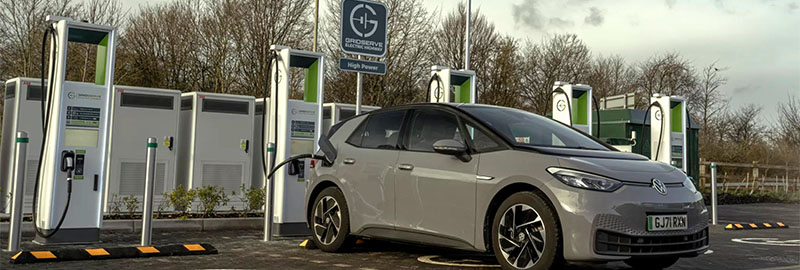
Public charging points are also an option, depending on your running cost budget and mileage that you need to do. There could be on street EV charging options near you (check resources like Zap Map), but there will be destination chargers, as well as rapid chargers available to keep you topped up and on the move.
Check out Smart Home Charge's cost to charge tool to compare the prices you can expect to pay for your specific EV based on charging at home, at destination or rapid chargers at public charging stations.
Look into workplace charging
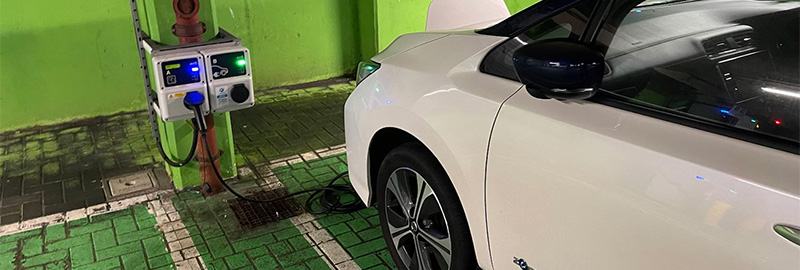
Many employers are installing workplace charging that allow you to charge your EV while you're at the office.
The Workplace Charging Scheme (WCS) is Government funded scheme that provides financial support to businesses wishing to have EV charge points installed at their work premises.
It means that if your employer doesn't currently have chargers in place, they can apply for funding to help towards the cost of that infrastructure.
The WCS is a voucher-based scheme that contributes up to £350 towards the upfront costs of a car charging point purchase and installation.
Explore all your options to install an EV charger without a driveway

Hopefully this guide has dispelled any of the myths around charging without off-street parking.
New solutions like cable gullies and charging arms let drivers run cables safely across pavements, with many councils now approving installations. Government grants of up to £350 can help cover costs, and some local authorities have extra funding available.
If fitting a charger isn’t an option, drivers can still use peer-to-peer charger sharing, on-street or public networks, or workplace charging schemes.
With more technology and funding becoming available, home charging is now possible for far more drivers in homes without driveways, contributing to the overall EV infrastructure .
If you're ready to move ahead with your charge point, Smart Home Charge is an approved Government charge point installer and has chargers, accessories and tools ready to set you up with your plugged-in vehicle.
Last updated: Dec 2, 2025
Related content